
PESO Approval
The Petroleum and Explosives Safety Organization, abbreviated as PESO, is a mid-level nodal organization founded in September 1898. This organization is mainly responsible for managing and administering risky substances such as biochemicals, gas cylinders, petroleum, and explosives that possess their own significance and risk to several human lives.
Different divisions of the PESO are as below:
This PESO organization functions under the policy of agreement “Safety First” in a queue with the powers granted to it by the policy mentioned below:
- Explosive Act 1884
- Petroleum Act 1934 & Rules 2002
- Cinematographic Film Rules 1948
- Inflammable Substance Act 1952
- Calcium Carbide Rules 1987
- Ammonium Nitrate Rules 1987
- Gas Cylinders Rules 2002
We are all aware of how dangerous petroleum and compressed gases are and how even a single ignition coming into contact with them can cause a catastrophe that puts human life in danger. Hazards associated with compressed gases are that they are combustible, poisonous, oxidizing, and corrosive.
For more than a century, the PESO has achieved a legendary grade as an organization of distinction in the regions connected to risky material safety in refining/manufacturing, storage, handling, transportation, and usage. Today, the PESO organization works on various topics such as petroleum, compressed gases, explosives, gas cylinders, cross-country pipelines, ammonium nitrate, flameproof electric fittings, and others.
Products Covered by PESO
Here is a comprehensive list of the products that require certification. A PESO registration is necessary for electrical equipment that must endure extremely corrosive seawater or extremely hot situations in addition to the aforementioned products. Purely mechanical parts that are employed in hazardous regions in India must also get PESO certification.
For explosion-proof products, one may often adhere to a pretty straightforward rule: PESO is required for all items that require either IECEx or ATEX certification.
Process of PESO Certification
- Documentation
Prepare the application with the necessary paperwork, including the test results and ATEX/IECEx certificates. Test results must be at least two years old. Equipment that has undergone thorough testing and been given the all-clear to operate safely in an explosive or hazardous environment is given an ATEX certificate. IECEx is a certification to standards for equipment used in explosive or dangerous environments. - Submission of Application
Submit your application to the PESO authorities together with the necessary business information, such as sales figures, client lists, and client testimonials. - Scrutiny
The paperwork and application are reviewed by PESO officials. - Audit
Only specific products, such as pressure vessels, are subject to factory audits. - PESO Certification
The PESO Certificate will be issued if PESO personnel are satisfied with the supporting documentation and test results.
- Documentation
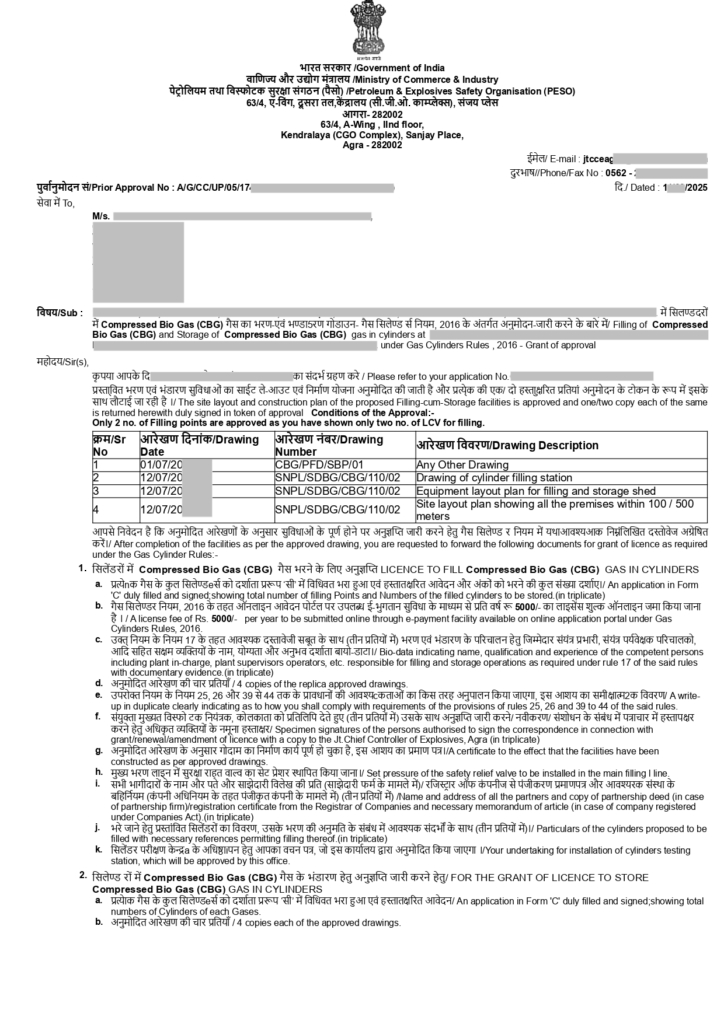
- License to Authorized Indian Representatives
Additionally, the authorized Indian representative receives a license. - TAT
90 – 100 Days - License Validity
After three years have passed, the license must be renewed. Static pressure vessel PESO licenses are only good for three years before they need to be renewed.
- License to Authorized Indian Representatives
Please Note
Once the PESO license has been approved, the product may be imported. The authorities typically accept test reports that have received international recognition, such as IECEx or ATEX. In any case, the products must be assessed in India if you don’t have these test findings.